-
Review: “Malice Aforethought” by Francis Iles
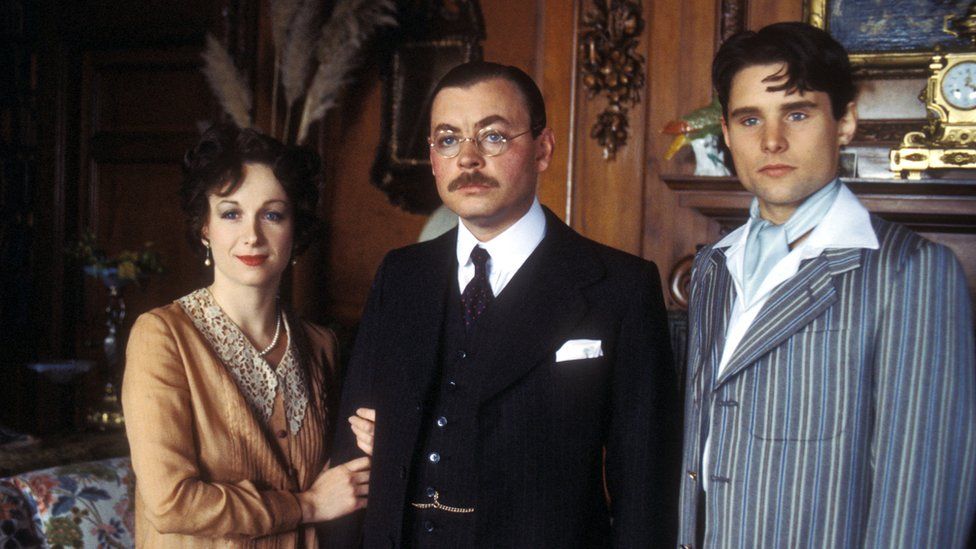
SYNOPSIS: “It was not until several weeks after he had decided to murder his wife that Dr Bickleigh took any active steps in the matter.”
Edmund Bickleigh lives a quiet life as a country doctor in the Devonshire countryside. After falling for the mysterious Madeleine, he is refused a divorce by his wife, the dictatorial Julia, and Bickleigh conspires to use his medical knowledge and resources to murder her – but will pride prove to be his downfall?
BACKGROUND: Malice Aforethought is the first book British detective writer Anthony Berkeley Cox published under the name ‘Francis Iles’. That wasn’t his only pen name; whilst he was more commonly known as ‘Anthony Berkeley’, 1927’s The Wintringham Mystery was also published under ‘A. Monmouth Platt’, and his first two detective novels, The Layton Court Mystery (1925) and The Wychford Poisoning Case (1926) were published anonymously. As ‘Anthony Berkeley’, his Roger Sheringham mysteries were largely conventional detective stories. They played with the formula in that Sheringham was fallible, and often mistaken in his deductions, but the structure was generally recognisable. Malice Aforethought, as with his other Francis Iles novels, is something else.
Basically, the novel is what’s known as a reverse-whodunnit: a murder mystery, but we follow events from the killer’s point of view, with the tension being generated from finding out how they inevitably get caught out. If that sounds at all familiar, it’s because the format would later be popularised by the Peter Falk television series Columbo (1968, 1971-1978, 1989-2003). Cox wasn’t the first to use this structure – a proto-version can be seen in Dostoevsky’s Crime and Punishment (1866) – but he was certainly a key developer of it, along with his contemporary R. Austin Freeman. Some of his other novels run along similar lines, like Jumping Jenny (1933; also published as Mrs Stratton’s Dead) and Trial and Error (1937) – whilst these examples aren’t true reverse-whodunnits, it’s characteristic of Cox’s work to play with exactly how much the reader is told. Thanks to the strong characterisation, Malice Aforethought is definitely Cox’s strongest outing in this sub-genre.
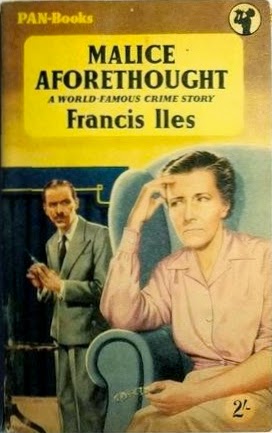
REVIEW: The biggest asset Malice Aforethought has going for it is the central character, Doctor Edmund Bickleigh. Cox has a careful line to tread here – you don’t want to spend 240 pages with someone you can’t stand, but he can’t be too sympathetic or likeable. After all, he’s a murderer. Nonetheless, Cox manages it, and as a result, we have a compelling protagonist.
Given their limited roles as satellites of Bickleigh, the other characters are sufficiently fleshed-out. Bickleigh’s first love interest, Ivy, for example, is introduced to us as being almost childlike in her unrequited infatuation for Bickleigh.[1] Over the course of the novel, she ebbs and flows between hating and loving Bickleigh, whilst he treats her with either contempt or outright apathy. It’s a relatively simple relationship, but Cox realises it well. A grown woman unable to see what Bickleigh for what he is should be irritating, but here, it works.
Where the novel falls a little flat, though, is the ‘detective’ side of things. Bickleigh’s murderous plots are paradoxically too simple and too convoluted. He offs Julia by lacing her food with an obscure medication that will trigger severe migraines, and then uses the migraines to get her addicted to morphine, which he then uses to give her an overdose. His other victims, however, get the ol’ “Botulism in the tinned meat sandwiches” trick.[2] In both cases, he is the only real suspect – Julia’s was intended to appear self-inflicted, and the sandwiches were meant to come across as food poisoning. As such, the police work that sees Bickleigh be apprehended comes across as a little basic. There’ve been two unusual deaths in the same village within a year of each other, and the only person with any real motive for either of them just so happens to be a doctor. There’s not much cat-and-mouse, back-and-forth interplay going on, which really would have boosted the novel a bit. The few instances we do get of this happening are excellent, so it’s a shame there wasn’t more on offer.
The ending does scrape back a few points, though. Cox loved a twist ending (he was the M. Night Shyamalan of detective fiction) and Malice Aforethought is no exception. As Cox’s twist endings go, it’s perhaps not the best – though we’ll get to that one soon – but it works well enough for the story.
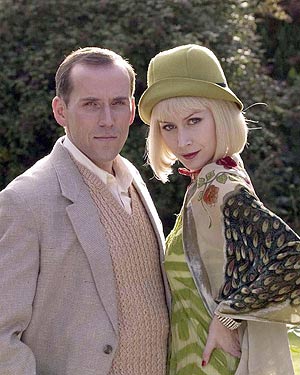
BENEATH THE SURFACE: It’s pretty easy to see Bickleigh’s insecurities as being at least partly rooted in gender. Not only is he shorter than this wife, but she dominates the household. Indeed, our first sight of the late Julia Bickleigh is her barking at Edmund to get things ready for the tennis party that afternoon; it’s no secret who wears the trousers in that relationship. This splashes over into his interactions with the other female characters, particularly the naïve Ivy and the duplicitous Madeleine: he dreams of himself as a great lover, but just comes across as a pathetic creep.
There’s also a definite class subtext to Bickleigh’s characterisation. Early on, we’re given the backstory of his and Julia’s early courtship, his humble upbringing is contrasted against Julia’s more aristocratic one. One of his fantasies, for instance, is to become Lord Bickleigh of Wyvern. And the first thing we see the doctor doing after the timeskip following Julia’s death is enjoying a glass of port: “Since Julia died he had been able to afford these little luxuries.”
And ultimately, money (or the lack thereof) turns out to be Bickleigh’s undoing. Having burnt through his estate to fund his legal defense, Bickleigh is acquitted of Julia’s murder at the end of the novel – however, he is immediately rearrested for Denny’s death, and is indicted. The implication here is that his duplicitous ‘innocent’ verdict was possible only with money to throw at the problem; take that money away, and justice finds its way.
Another little point of interest is the use of phonetic spelling. The majority of detective writers at the time were middle-class, so whenever a working-class character appeared, dey ooz’ly torked loik dis.[3] Malice Aforethought, though,goes the other way,. When the prim Gwynyfryd Rattery appears early on, her dialogue is marked by her cut-glass voice: “Ay’m gooing,” she declares, after turning down Bickleigh’s advances. Similarly, the narration pokes fun at Julia’s voice at one point, writing that she says “It doesn’tt do to take things casu-ally”, rather than the more normal “It doesn’ do t’ take things casuly”.
Of course, Cox wasn’t exactly Billy Bragg. I counted no fewer than three characters who use the working-class phonetic spelling – all of them servants, I’m sure you’ll be surprised to hear – and these class anxieties are all somewhat dulled by the Middle England setting. This is a world of tennis parties, house servants and dilletantes, not dole queues, poverty and starvation. Bickleigh’s class aspirations and resentments are alluded to early on, as part of his introduction, but they never really mesh with the rest of the plot. Julia might be overbearing, but killing her won’t raise his social standing an inch.
USELESS TRIVIA OF THE WEEK: The Home Office medical expert in Bickleigh’s trial at the end is named ‘Clerihew’, a reference to Edmund Clerihew Bentley. As E. C. Bentley, he published one of the most important books in the Golden Age of detective fiction, Trent’s Last Case (1913), and went on to be the second president of the Detection Club. He also gave his name to the Clerihew, a type of poem he originated.
Bickleigh’s poisoning of the sandwiches was possibly inspired by the real-life death of Alice Thomas, in October 1930. After eating sandwiches prepared by her friend, Annie Hearn, Thomas died of arsenic poisoning; Hearn was later acquitted at trial, then promptly disappeared from public life. You can read more here: https://launcestonthen.co.uk/index.php/the-place/launceston-police/the-trial-of-annie-hearn/
VERDICT: The weak detective work is more than made up for with a strong main character, captivating pace, and pitch-black humour. 9/10.
Next time, we’re diving into Agatha Christie with The Mysterious Affair at Styles, as we meet a certain Belgian for the first time…
[1] Yes, the very clingy character is called ‘Ivy’. Cox is nothing if not subtle.
[2] Because nothing says the high life like a spam sandwich.
[3] As a sidenote, it once really annoyed me to see a working-class character written to say “chocolate” as “chocklit” – how else are you meant to pronounce it?!
-
Hello World!
Welcome to WordPress! This is your first post. Edit or delete it to take the first step in your blogging journey.
-
Subscribe
Subscribed
Already have a WordPress.com account? Log in now.
 Murder Most Meta